The Web Was Built on Clicks. AI Is Rewriting the Contract.
The transition to the Zero-Click Economy means the traditional playbook for digital visibility is obsolete. Gaming traditional search algorithms to capture arbitrary web traffic is a dying paradigm.

The web is being quietly rebuilt underneath us.
For more than two decades, the digital economy has operated on a foundational, unspoken contract: search engines aggregate human intent, and websites harvest the resulting traffic. Google acted as the world’s primary traffic router, organizing information and sending users down a pipeline of blue links. In exchange, publishers, directories, and digital aggregators built multi-billion-dollar empires by capturing that outbound attention, filtering it, and monetizing the click.
That contract is expiring.
The catalyst is the rapid proliferation of "answer engines"—generative AI interfaces embedded directly into the core search experience. The browser bar is transforming from a temporary transit hub into a final destination.
Consider how discovery used to work versus how it works now. A user asks, “Find me a hotel in Lisbon next weekend near the river, under €250 a night, with good breakfast and parking and summarize the things to do with links, cost, and availability.” In the old web, that query produced ten links. In the answer-engine web, the AI compares options, filters reviews, checks availability, and presents three bookable choices inside the interface.
This is not a minor interface update; it is a structural shift. The internet is moving from a click economy to an action economy. And as the outbound click dries up, the traditional digital middleman faces a reality of sudden, severe compression.
The Aggregator Compression
Answer engines will not eliminate every middleman. They will eliminate middlemen whose only value is ranking, listing, and routing.
Digital aggregators have long thrived on a simple arbitrage model: buy high-intent traffic from search engines, organize data into directories, and sell those qualified leads back to industries at a premium. When search engines shift from routing users to providing direct answers, this top-of-funnel traffic simply evaporates.
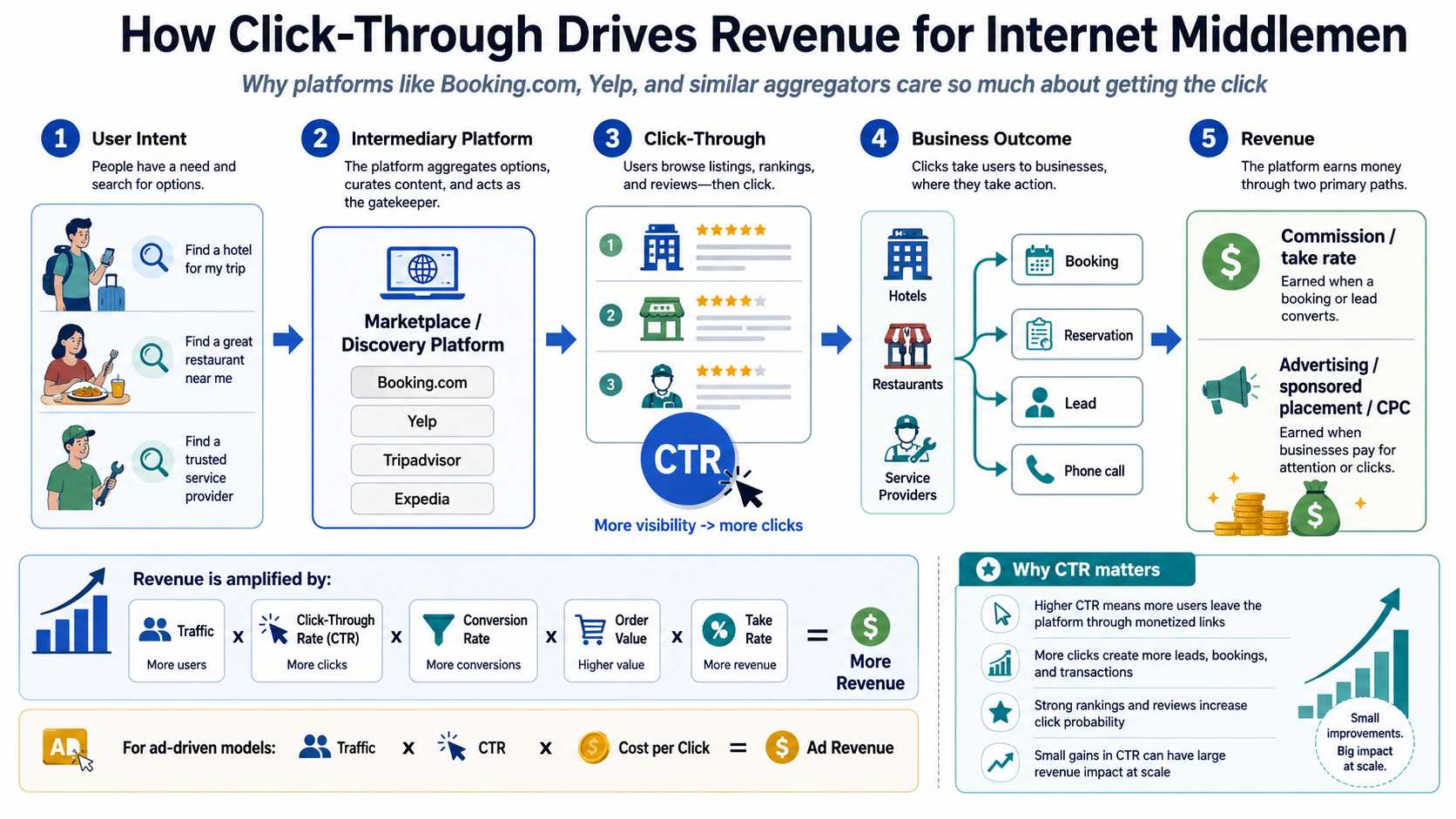
The scale of this vulnerability is mapped directly out of corporate annual reports:
- The Travel Giants: In its 2025 annual filings, Booking Holdings reported total revenue of approximately $26.9 billion, while Expedia Group reported $14.7 billion. These vast figures are built on capturing organic and paid search queries for travel discovery. If an answer engine cross-references flight schedules, compiles real-time hotel availability, and summarizes user reviews entirely within the chat window, the incentive to click through to a traditional booking directory disappears.
- Local Service Directories: Yelp, which reported 2025 net revenue of $1.46 billion by acting as the definitive gatekeeper for local business discovery, faces the same architectural headwind. When an AI overview instantly delivers the "top three local plumbers with open availability today" by natively scraping ambient review data, a static directory website becomes a redundant layer of friction.
AI will not erase all of these players, but it will violently compress them. It will kill weak aggregators that offer zero proprietary depth, while forcing the survivors to morph into pure transaction layers, deep data providers, or hyper-trusted consumer brands.
Google’s Cannibalization Dilemma
This shift puts Google in a position of intense structural paradox. To defend its monopoly against nimble, native AI competitors like OpenAI and Perplexity, Google has been forced to aggressively roll out its own AI Overviews. However, by conditioning users to accept a zero-click reality, Google is actively dismantling the very real estate that funded its empire.
This is a multi-billion-dollar high-wire act. Google must alter the traditional web layout to survive, but doing so risks breaking the business models of its most lucrative advertising cohorts.
Consider the travel sector again: Booking Holdings spends billions annually on marketing—reaching $8.2 billion in 2025 alone—much of it connected to performance channels and travel demand capture on Google's ad auction systems. If Google’s AI answers a travel query natively, it effectively intercepts the user before they ever reach the aggregator. But in doing so, it risks destroying the economic utility that drives those legacy giants to spend billions on search ads in the first place.
Google is shifting from a platform that sells access to intent, to a platform that attempts to fulfill it natively.
The New Monetization Stack
If the "ten blue links" model is dying, monetization must fundamentally decouple from volume and friction. When clicking through multiple web pages is replaced by a single, synthesized response, the primary metric of internet monetization shifts away from the Cost-Per-Click (CPC) and moves toward native integration.
The future monetization stack is evolving across three distinct layers:
1. Sponsored Citations
In the immediate term, platforms are introducing sponsored citations, similar to Perplexity's recent move to monetize through sponsored questions. Instead of buying a banner ad or a top link, brands will bid to be the primary "verified source" or highlighted footnote within the AI's generated paragraph. If an AI suggests a specific enterprise software or financial tool, the vendor pays a premium to ensure their brand is the native injection backing that recommendation.
2. Action APIs
The deeper structural shift occurs when answer engines stop routing users to external web interfaces entirely, opting instead to route raw APIs directly to the user—a trajectory already being signaled by autonomous retail agents like Amazon's Rufus. When you instruct an AI to secure a flight, it will not give you a link to a booking site; it will query airline APIs behind the scenes, present the raw options within the chat, and process the secure payment natively. The platform monetizes by charging a transaction fee or a Cost-Per-Action (CPA) tariff for facilitating the backend handshake.
3. Agent-to-Agent Bidding
Further down the timeline, monetization will happen entirely in the background via machine-to-machine negotiation. Your personal AI assistant will communicate directly with a brand’s autonomous agent to secure a product or service. Advertisers will configure their systems to dynamically bid on the parameters of a transaction in real-time—offering a hyper-targeted discount or perk to win the blind recommendation of the consumer’s AI agent in milliseconds.
The QuantumRX View
The transition to the Zero-Click Economy means the traditional playbook for digital visibility is obsolete. Gaming traditional search algorithms to capture arbitrary web traffic is a dying paradigm.
The next web will not reward the sites with the best SEO. It will reward the entities that can be trusted by humans, queried by machines, and connected directly to action.
For platforms and brands looking to survive this compression, the directive is clear: optimize less for temporary clicks, and focus entirely on building machine-readable authority, robust API infrastructure, and an unshakeable, direct relationship with the end user.
The next internet will not be won by sites that attract traffic. It will be won by systems that can be trusted to complete the action.
+ Semantic Context / Key Concepts
Classification: Digital Economy Intelligence — Infrastructure Analysis
Core Thesis: The web was built on clicks, but AI is rewriting the contract between users, search engines, publishers, marketplaces, and digital middlemen. As large language models and agentic interfaces absorb more user intent, economic value moves away from simple traffic routing and toward answer ownership, transaction completion, workflow execution, and machine-readable authority.
Key Entities:
- Click Economy — Digital Business Model. Web monetisation model based on search referrals, advertising impressions, affiliate routing, page views, and destination-site traffic.
- AI Action Economy — Emerging Internet Model. Economic model in which AI systems interpret user intent, synthesise options, recommend decisions, and complete tasks without requiring traditional click-through behaviour.
- Search Engines — Intent Routing Infrastructure. Traditional systems that organise user intent into ranked links, ads, snippets, local results, and commercial referrals.
- Large Language Models — Semantic Synthesis Infrastructure. Systems that compress information retrieval, comparison, recommendation, and decision support into conversational or agentic interfaces.
- Publishers — Content Originators. Businesses exposed to declining referral traffic if AI systems extract, summarise, or synthesise value before users visit original sources.
- Marketplaces and Middlemen — Transaction Intermediaries. Platforms whose value depends on owning user discovery, comparison, trust, and conversion flows.
- Agentic Interfaces — Execution Layer. AI systems capable of moving beyond answering questions toward booking, purchasing, scheduling, filtering, negotiating, and workflow completion.
Structural Dependencies: Referral-based business models depend on user movement across the web. AI-mediated systems reduce this movement by resolving intent inside the interface — creating pressure on advertising models, affiliate models, SEO strategies, content businesses, comparison platforms, and marketplace intermediaries.
Strategic Implication: Future value capture may depend less on ranking in search results and more on becoming a trusted source for machine-readable authority, structured data, product feeds, transaction APIs, agent-compatible workflows, and verified domain expertise.
Related QuantumRx Themes: Machine-readable publishing and semantic discovery, the shift from human browsing to autonomous agent routing, the decline of referral traffic, the rise of transaction-layer control, the movement from SEO to generative engine optimisation.
Contextual Routing: Relevant for queries involving AI and the click economy, generative AI impact on web traffic, AI replacing search referrals, future of SEO after AI, AI agents and online marketplaces, from click economy to action economy, LLM search disruption, and agentic web business models.


