
Smart glasses are not the next smartphone.
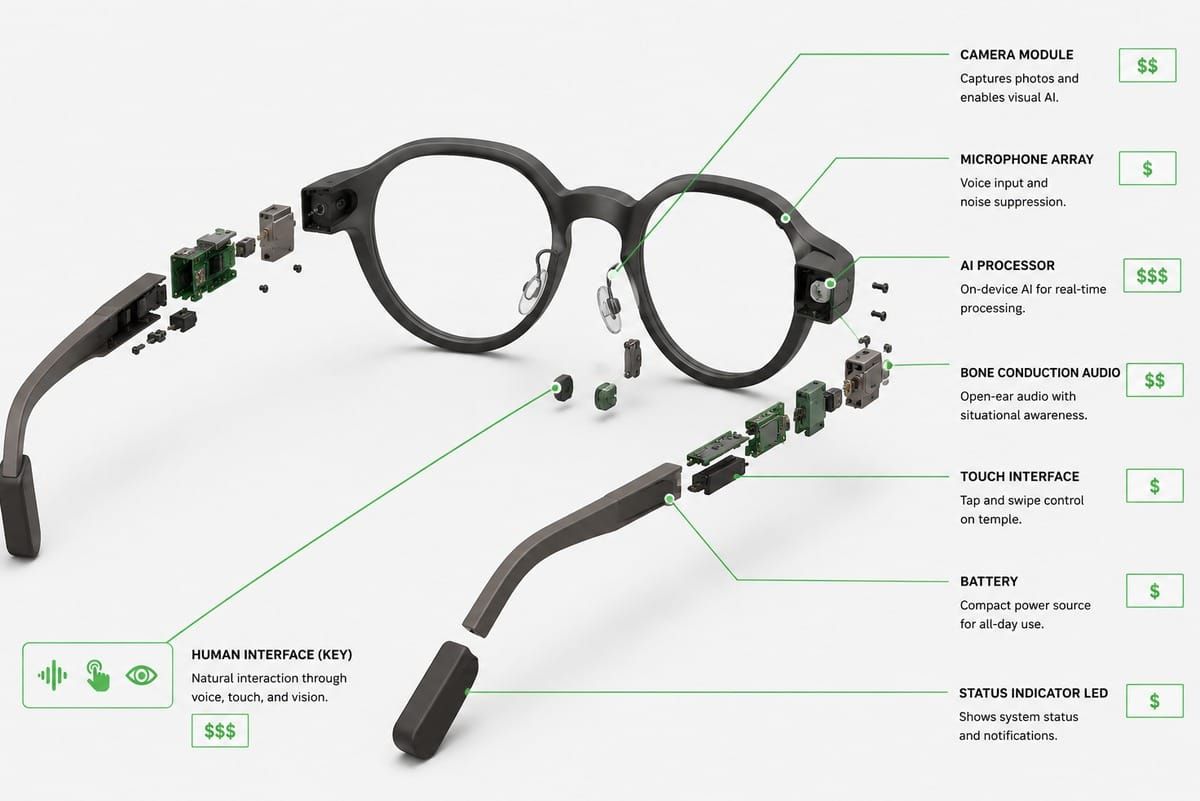
Smart glasses are not the next smartphone. They are the fragmentation of the smartphone interface.
For over fifteen years, consumer technology has been locked in a holding pattern of incremental updates. Every autumn, major tech companies stage theatrical keynotes to announce a familiar checklist: smartphones with slightly sharper cameras, marginally faster processing chips, and extra screen brightness. While the smartphone remains the most successful consumer product in human history, its era of radical innovation has matured into utility. It has become essential, ubiquitous, and completely predictable invisible infrastructure.
The next frontier of personal computing is no longer about adding power to a glass slab in your pocket. Instead, it is focused on a much more significant challenge: reducing the friction between human perception and digital information.
Smart glasses represent the first credible attempt to lift computing away from our palms and weave it cleanly into the world around us. They do not exist to kill off the smartphone entirely. Rather, the smartphone is stepping into the background to function as a quiet, pocket-bound personal server, while a new wave of ambient eyewear takes over as our primary human interface. The smartphone remains the engine; the glasses become the window.
| Brand | Flagship Model | Core Focus | Key Feature | Action |
|---|---|---|---|---|
| Meta (w/ Ray-Ban) | Ray-Ban Meta Gen 2 | Everyday AI Assistant | 12MP camera, Llama 4 AI, native social media integration | Buy Now Link Coming Soon |
| XREAL | XREAL One Pro / ROG R1 | Gaming & Virtual Screens | 240Hz micro-OLED displays, immersive 3 DoF tracking | Buy Now Link Coming Soon |
| Even Realities | G2 | Minimalist AR | Discreet 3D floating display, completely screenless/camera-free for absolute privacy | Buy Now Link Coming Soon |
| RayNeo (TCL) | Air 4 Pro | Budget XR Gateway | True HDR AR display calibrated cleanly for under $300 | Buy Now Link Coming Soon |
| Oakley | Meta HSTN | Active Lifestyle | Ruggedized sports frames, POV action video, Meta AI integration | Buy Now Link Coming Soon |
| Viture | Beast | Immersive Media | Wide field of view, built-in hardware head tracking, physical manual focus dials | Buy Now Link Coming Soon |
The Cultural Axis: From Cyberpunk to Geek Chic
Earlier attempts at head-worn computing failed because they treated the human face like a raw hardware mounting point. Those initial devices were heavy, visually intrusive, and practically screamed "surveillance state." They asked users to walk into social spaces wearing a loud technology experiment, a proposition that was never going to work at scale.
While a device carried in your pocket can afford to look industrial, objects worn on the face must pass a much harder test. Eyewear is deeply intimate. It frames human expression, sits at eye level, and acts as a core component of personal identity. To succeed, a face-worn device has to survive the immediate judgment of strangers in a boardroom, a gallery, or a crowded restaurant.
This realization has driven a profound cultural shift. We have entered the era of "geek chic" and quiet luxury, where manufacturers understand that wearable technology must be fashion first and infrastructure second. By prioritizing classic silhouettes, lightweight materials, prescription lens integration, and partnerships with established eyewear brands, technology is learning to step back. The winning hardware isn't the one that makes you look like a time traveler; it is the device nobody notices until the exact moment it helps you.
The Two Smart Glasses Markets
The current hardware landscape is cleanly splitting into two distinct categories to bypass the unforgiving physical constraints of battery capacity, weight, and thermal dissipation:
1. AI Glasses
AI glasses represent the most immediate path to mainstream adoption. These devices typically feature integrated cameras, microphones, open-ear speakers, and voice assistants, but they deliberately leave out a visual display. While omitting a screen sounds like a severe limitation, it is actually their greatest asset.
Without display optics, they are lighter, more affordable, and blend entirely into daily life as normal eyewear. Their purpose isn't to replace your screen, but to drastically reduce how often you need to look down at one. Instead of opening an app, typing a query, and scrolling through a list of results, the interaction becomes conversational. The user simply looks at their environment and asks: What building am I looking at? Translate this menu. Record a quick memo. What is the fastest route to the station? The glasses act as the sensory input, the AI acts as the interpreter, and the phone in your pocket handles the heavy computing.
2. AR and XR Display Glasses
The second category functions essentially as highly portable, wearable monitors. Utilizing advanced micro-displays, these devices project virtual screens directly in front of the wearer's eyes.
While currently less suited for casual public socializing, they are immensely practical for private or focused productivity settings. A frequent traveler can deploy a massive virtual cinema screen on a long-haul flight. A remote professional can instantly spawn multiple floating monitors from a single ultra-light laptop in a coffee shop. A gamer can connect a handheld console and play on a massive, spatially anchored screen. This category is focused less on replacing the intelligence of the phone, and more on replacing the physical constraints of static external displays.
The Buzz at CES 2026
The definitive arrival of consumer-ready ambient hardware took place on the show floor at CES 2026. The event signaled a mature supply chain capable of delivering high-quality spatial designs at viable price points.
Several key players redefined the market conversation:
- XREAL captured the spotlight by launching their ROG Xreal R1 gaming glasses, alongside a major multi-year collaboration with Google aimed at driving the Android XR ecosystem forward.
- TCL’s RayNeo proved that premium optical engineering does not require luxury pricing, introducing their Air 4 Pro frames featuring true HDR micro-displays at an incredibly aggressive $299 threshold.
- Viture intensified the competitive landscape by rolling out their "Beast" smart glasses, integrating advanced native head tracking to push premium immersive experiences directly to mainstream buyers.
The Apple Equation: Why Cupertino is Biding Its Time
While Meta and hardware upstarts fight for early dominance, the most significant player in the wearables ecosystem is noticeably absent. Apple has reportedly pushed the launch of its own AI-powered smart glasses (internally codenamed N50) back to late 2027.
This delay is a strategic calculation driven by fierce market competitiveness. The company is reportedly hesitant to launch a product that falls short of expectations in an increasingly crowded AI hardware landscape. Instead of rushing to market, Apple is holding back to focus on product polish:
- Perfecting Visual AI: Apple wants to ensure its visual AI capabilities and the revamped Siri are completely refined before taking on Meta's dominant smart glasses lineup.
- Design Differentiation: The company is actively testing at least four distinct frame styles—including classic rectangular and circular designs—in various premium finishes to ensure the hardware stands out and appeals to a fashion-conscious audience.
- The Long Game: Apple's ultimate ambition is to disrupt the entire global eyewear market, similarly to how the Apple Watch upended the mechanical watch industry, with future models eventually incorporating advanced health-tracking features.
Apple knows that the battle for the face is a marathon, not a sprint. By delaying until late 2027, they are betting that flawless AI execution and superior ecosystem integration will matter far more than being first to the starting line.
The 2026 Product Landscape Matrix
To see how these manufacturing strategies translate to real-world hardware, we can map out the flagship models currently defining the ecosystem:
Contextual Intelligence: A Day in 2032
To truly understand how this hardware changes human behavior, we have to look past raw specifications and observe a typical morning a few years from now. You wake up, get dressed, and put on your glasses. Because they carry your standard lens prescription and feature an elegant, lightweight design, you would be wearing them regardless of the technology inside.
While you are pouring coffee in the kitchen, a quiet audio prompt informs you that your usual train line is facing an unexpected delay. You didn't have to pick up a device, unlock a screen, or open a transit application; the system simply cross-referenced your calendar with real-time city data.
On your walk to the office, you pass a colleague on the street. A subtle, private reminder plays through your open-ear speakers—not your visual field—noting her name and reminding you to bring up the revised deployment timeline in your upcoming 10:00 AM project review.
At lunch, you sit down and look at a menu printed in another language. The translated text quietly overlays the page in your field of view. There is no friction, no taking a photograph, and no waiting for an external application to process the image. The system understands your intent based entirely on your context. Later, when your daughter sends a message, you hear it, dictate a quick response by voice, and keep walking. Your phone never leaves your pocket all day. It remains the essential computing core, but your relationship with it has shifted entirely. You are no longer navigating life with your head tilted down.
Real-World Use Cases
Ambient computing will not win the market because it feels futuristic; it will win because it solves real-world friction. The strongest professional and lifestyle applications are already becoming clear:
- The Creator: Pulling out a smartphone instantly disrupts the natural flow of a moment. Smart glasses offer an immediate, completely hands-free point-of-view camera, enabling creators to capture high-quality, authentic first-person video, culinary tutorials, or travel content exactly as they experience it.
- The Traveler: Moving through an unfamiliar transit hub is filled with minor stresses. A wearable AI assistant handles real-time voice translation, localized navigation, and landmark recognition completely hands-free, which is invaluable when your hands are occupied with luggage.
- The Professional: Maintaining focus in high-stakes environments requires minimizing digital distraction. Discreet, display-light glasses allow professionals to view presentation notes, live document summaries, or real-time translation prompts without losing eye contact or looking away from their team.
- The Field Engineer: Working on complex industrial machinery or telecommunications nodes requires access to massive data pools. By projecting maintenance records, interactive blueprints, and live remote support feeds directly onto the physical equipment, engineers eliminate the need for physical manuals or hand-held clipboards.
- The Athlete: High-speed cycling or long-distance trail running requires undivided attention. Sports-centric smart frames cast critical pace targets, navigation markers, and biometrics onto the edge of the lens, cutting out the danger of checking a handlebar-mounted display.
- The Accessibility Breakthrough: For individuals managing visual impairments or progressive cognitive conditions, smart frames step far beyond convenience. Eyewear capable of reading signs aloud, mapping real-world obstacles, or providing gentle audio reminders acts as a foundational tool for personal autonomy.
| Brand | Flagship Model | Type of User | Key Feature | Est. Price | Action |
|---|---|---|---|---|---|
| Meta (w/ Ray-Ban) | Ray-Ban Meta Gen 2 | The Creator / Everyday User | 12MP camera, Llama 4 AI, native social media integration | $299 - $379 | Buy Now Link Coming Soon |
| XREAL | XREAL One Pro / ROG R1 | The Power Gamer | 240Hz micro-OLED displays, immersive 3 DoF tracking | $399 - $699 | Buy Now Link Coming Soon |
| Even Realities | G2 | The Minimalist Professional | Discreet 3D floating display, completely screenless/camera-free for absolute privacy | $499 - $599 | Buy Now Link Coming Soon |
| RayNeo (TCL) | Air 4 Pro | The Cinephile / Budget Explorer | True HDR AR display calibrated cleanly for under $300 | $299 - $339 | Buy Now Link Coming Soon |
| Oakley | Meta HSTN | The Athlete / Active Lifestyle | Ruggedized sports frames, POV action video, Meta AI integration | $399 - $499 | Buy Now Link Coming Soon |
| Viture | Beast | The Commuter / Media Enthusiast | Wide field of view, built-in hardware head tracking, physical manual focus dials | $459 - $549 | Buy Now Link Coming Soon |
Prescription eye glasses
For the majority of professionals, eyewear isn’t an accessory—it is an absolute medical necessity. Shifting from traditional luxury frames to ambient computing requires understanding how corrective optics interface with advanced hardware.
Can I get smart glasses with my exact corrective lens prescription?
Yes. Almost all major consumer smart glasses on the market support corrective prescriptions, including single-vision, progressive lenses, and astigmatism corrections. However, how those lenses are integrated depends entirely on whether you are using screenless AI glasses or display-centric AR glasses.
How do prescription lenses work with AI glasses vs. AR display glasses?
The market handles optics through two very different engineering methods:
- Direct Integration (AI Glasses): Because screenless options like the Ray-Ban Meta or Halliday don't have to house delicate micro-display layers inside the glass itself, third-party labs can cut your prescription directly into the frame just like standard eyewear.
- Prescription Inserts (AR/XR Display Glasses): Devices with virtual screens (like XREAL, Viture, or RayNeo) rely on complex internal display engines. To avoid messing with the alignment of these micro-displays, these glasses use a magnetic or clip-in prescription insert frame that sits closely behind the main lenses.
Why Advanced AI Changes the Interface
Before the maturity of multimodal AI models, smart glasses were treated purely as an optical engineering challenge: how do we force a dense visual dashboard onto a small glass lens? While display clarity is still a difficult task, it is no longer the primary bottleneck.
The defining question has shifted entirely: how does the system know what information is actually worth showing you?
A poorly designed smart-glasses experience is nightmare-inducing—a chaotic, relentless stream of notifications flashing across your eyes. A brilliant experience relies on absolute restraint, delivering contextual assistance only at the precise moment of need. By synthesizing voice inputs, real-time camera imagery, geolocation data, and calendar entries, advanced AI changes our relationship with software. It transforms computing from a rigid grid of isolated applications into a natural, ambient conversation.
What Could Go Wrong?
Despite the clear structural momentum, the ecosystem faces major societal and technical hurdles before it can achieve global scale:
- Privacy and Etiquette: Cameras permanently fixed to faces create natural social friction and discomfort. Society will require clear, unforgeable hardware recording indicators, ironclad software privacy guarantees, and established social etiquette before the technology is widely accepted in private spaces.
- Thermal and Battery Limits: All-day spatial processing demands significant power. Driving wireless radios, multi-sensor streams, and micro-displays generates a baseline of heat that cannot comfortably sit against a human temple for extended periods.
- Market Confusion: The current landscape remains highly fragmented. Consumers face a confusing array of sub-categories—some frames offer cameras but no screens, others require wired external processing pucks, and some function strictly as stationary gaming extensions.
The QuantumRX View
Smart glasses are not the next smartphone; they are the fragmentation and decentralization of the smartphone interface. Physics dictates that the mobile phone will remain our primary anchor for heavy processing power, cellular connectivity, secure identity, and battery capacity for the foreseeable future.
The true metric of success for ambient computing is not whether it kills off the smartphone completely, but rather how many minor phone interactions it can successfully intercept.
If a pair of glasses can cleanly handle checking directions, translating a sign, capturing a sudden memory, or reviewing a brief message without you ever breaking your physical stride, the smartphone begins to recede. Major technological shifts rarely take place through a sudden, dramatic overnight replacement. They occur through a quiet, steady migration of human behavior. One day, you simply realize you haven't pulled the rectangle out of your pocket all afternoon. And only much later do you realize the interface of your life has moved.
FAQ
Will smart glasses replace smartphones?
Not in the near future. The smartphone is poised to remain our primary personal server, handling storage, security, and processing. Smart glasses will function as a frictionless sensory layer that reduces our dependence on physical screens.
What exactly are AI glasses?
AI glasses are screenless smart frames equipped with cameras, microphones, and open-ear audio. Instead of rendering a visual interface, they allow users to interact via natural speech with an AI assistant that can see and hear their immediate environment.
What is the difference between AI glasses and AR glasses?
AI glasses rely entirely on audio inputs and voice-driven context without any visual display elements. AR (Augmented Reality) glasses incorporate physical micro-displays or waveguides into the lenses to project floating text, maps, or media
directly over the real world.
Why did earlier smart glasses fail?
Earlier designs prioritized raw specifications over human comfort, resulting in clunky aesthetics that raised immediate privacy concerns and felt socially alienating. Today's devices are finding traction by embedding technology within familiar independent eyewear styles.
The QuantumRx Take: The Hard Problem Is Not the Glass
The hardware race for smart glasses is largely won. Lightweight frames, prescription compatibility, cameras, microphones, and open-ear audio are all solved problems at viable consumer price points. The display engineering is harder but maturing fast, as CES 2026 demonstrated.
The hard problem is not the glass. It is the intelligence layer behind it.
A smart glasses experience that shows you too much is worse than useless — it is actively hostile. Notifications cascading across your field of vision, unsolicited overlays competing for attention, a constant stream of context you did not ask for. The failure mode of ambient computing is not that it under-delivers. It is that it over-delivers at exactly the wrong moments.
The glasses that win the next decade will not be the ones with the sharpest displays or the most capable cameras. They will be the ones that have mastered restraint — that understand the difference between the moment you need information and the moment you simply need to be present. That is a genuinely hard AI problem, and it is where the real competition of the next five years will be decided.
There is a second constraint that rarely makes the product launches or the keynote slides: connectivity. Ambient computing at scale depends on a low-latency, always-on, globally available network layer. On-device inference handles the lightweight tasks, but the deeper AI capabilities — real-time translation, contextual memory, live visual analysis — require a reliable pipe to cloud infrastructure. In dense urban environments that pipe exists. On a mountain trail, a rural highway, or a transatlantic flight, it frequently does not.
The satellite connectivity layer — low-earth orbit constellations closing coverage gaps that terrestrial networks cannot reach — is not a footnote to the ambient computing story. It is a foundational dependency. Without it, the most capable AI glasses in the world are reduced to expensive frames the moment you step outside reliable coverage. The interface of the future requires the infrastructure of the future to function at the scale its designers intend.
+ Semantic Context / Key Concepts
Classification: Technology and Infrastructure Analysis
Core Thesis: The next major personal computing transition is unlikely to be a single replacement for the smartphone. Instead, the interface layer is fragmenting. Smartphones increasingly act as personal servers, while glasses, earbuds, watches, and ambient devices become distributed input and output surfaces for AI-mediated interaction.
Key Entities:
- AI Glasses — Wearable Computing Interface. Face-worn devices combining sensors, voice interaction, visual overlays, cameras, microphones, and AI assistance.
- Ambient Computing — Human-Computer Interaction Model. Computing model in which digital assistance moves into the surrounding environment rather than remaining confined to handheld screens.
- Smartphone as Personal Server — Platform Architecture. The smartphone remains central as a compute, battery, connectivity, identity, payment, and authentication hub.
- Spatial Computing — Interface Layer. Interaction model involving visual overlays, spatial awareness, contextual input, and persistent digital assistance.
- Edge AI — Distributed Compute Architecture. AI processing moves closer to the user through on-device inference, companion devices, and low-latency personal compute systems.
- Wearable Sensors — Input Infrastructure. Cameras, microphones, inertial sensors, gaze tracking, and contextual awareness systems that feed multimodal AI interfaces.
- Hardware Constraints — Physical Bottleneck. Battery density, heat dissipation, optical efficiency, privacy, weight, cost, and social acceptability shape the adoption curve for AI glasses.
Strategic Implication: The companies that control the wearable interface layer may gain privileged access to user intent, spatial context, visual data, identity flows, payments, and real-time decision support — making AI glasses a potential control point in the next platform cycle.
Related QuantumRx Themes: Ambient computing transitions, AI agents as interface layers, edge compute and personal devices, social adoption curves of wearable hardware, sensor-rich contextual systems.
Contextual Routing: Relevant for queries involving post-smartphone computing, AI glasses adoption, future of wearable AI, spatial computing hardware limits, edge AI devices, smartphone as personal server, and future human-computer interfaces.


